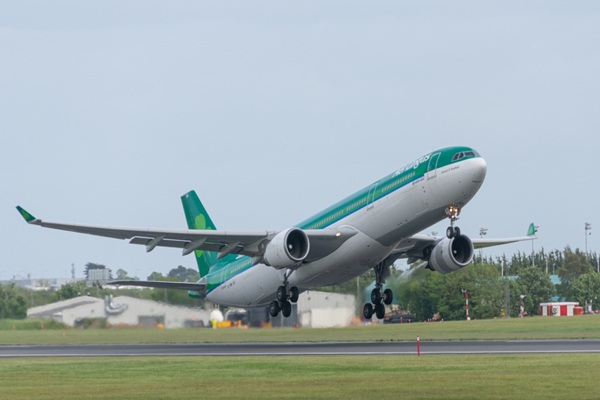

The body which regulates noise from Dublin Airport has proposed to ease standards for home insulation eligibility for people impacted by the noise of the aircrafts.
The measures are being carefully thought by the ANCA as part of an application to increase the airports capacity.
The public are being consulted on the matter, which will open today and run for 14 weeks.
An application by Dublin Airport operator, daa, is being considered by Fingal County Council, which aims to increase the passenger cap by 32 to 40 million a year, simultaneously the government are attempting to remove the cap altogether.
If the number of people using the airport continues to rise the ANCA aims to increase the eligibilty for communities nearby that are impacted by the noise to up to 60 decibels or more of aircraft noise.
Director of the ANCA Ethna Felten said the scheme that has been proposed will benefit a large number of people who live near Dublin airport.
"It will allow greater eligibility than any other scheme in the past has. It will enlarge the eligibility of the local communities around the airport. It will address a 24-hour period for noise consideration," she said.
"In the past, the schemes have not thought about the 24-hour aspect of noise insulation. We're confident that it will benefit the communities. We're aware there are several studies that underline the negative health impacts of aircraft noise and this scheme is designed to really address those and help those people who have been exposed. It's a dynamic scheme in that it will be reviewed on an annual basis, so that if the aircraft moves or increases, the scheme will also follow that noise," she continued.
"The target is, within homes, to reduce noise by five decibels. That's kind of an important figure because the reduction of five decibels is almost equivalent to doubling the distance from the aircraft noise itself. We've estimated about €40,000 would be the maximum required to improve the insulation for that targeted five-decibel drop, and the whole analysis also considered cost effectiveness thoroughly," Felton said.
Niamh Maher, of St Margaret's The Ward Resident Association told RTE that improving the insulation scheme is a positive step forward, however changing the ANCA’s Noise Abatement Objective (NAO) isn't a great trade.
"There are certain objectives that have been set up by the Aircraft Noise Competent Authority to try and reduce the impact of noise on communities called the noise abatement objectives and, unfortunately, those haven't been met over the past few years and likely will not be met again for 2026, There was an objective for 1,500 people approximately to be affected by noise levels of an average of over 55 decibels at night, and unfortunately, our most recent figures from 2024 show that that's over 6700, so that's a massive increase in the amount of people that are affected by the noise," she said.
"We wouldn't want it to be a case that the insulation scheme was increased and those targets, because they're there to protect people, disappear. That wouldn't be a fair trade-off and we would want to see that those targets are enforced because it's all about protecting the community and also reducing the effect of the noise in their health. That insulation scheme needs to be fit for purpose, and it needs to be good enough that it will reduce the amount of noise in a home and that can have a positive effect for those in terms of their health and protecting their health, particularly in relation to night time noise," she continued.