

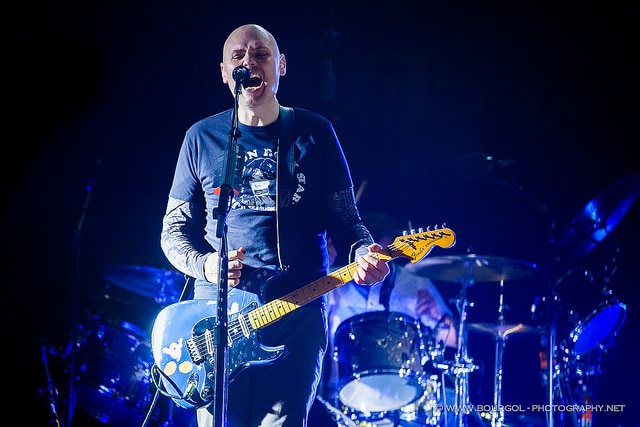
There are artists who expand when success arrives, and there are artists who treat success like a dare. Billy Corgan was always the second kind. When Siamese Dream turned The Smashing Pumpkins into a six-million-selling juggernaut in 1993, the sensible move would have been to breathe out, make something tidy, repeat the trick. Instead, Corgan decided to build a cathedral where a house would have done.
The result was 1995’s Mellon Collie and the Infinite Sadness, a double album so enormous it frightened the people paying for it. While the band were headlining the 1994 Lollapalooza tour alongside Beastie Boys, Nick Cave and the Bad Seeds, The Breeders, L7 and Green Day, Corgan went on MTV and casually announced his intention to follow up their breakthrough with a two-disc statement piece.
“The record label went into a panic. They told me I was insane, things like ‘career suicide’ and all that stuff was thrown around. It was seen as a sign of my growing hubris; ‘He’s gone mad’.”
From the outside, it probably did look like madness. The band; Corgan, James Iha, D’arcy Wretzky and Jimmy Chamberlin, spent eight months recording 57 songs, eventually chiselling them down to 28 tracks and a running time that pushed past two hours. Ambition became a kind of discipline, discipline became obsession, and obsession became the operating system.
Co-producer Flood wanted the record to feel like the band felt onstage: loud, volatile, dangerous. Corgan took that literally.
“We brought in a full PA so we would play at full volume,” he explains. “The old Pumpkinland, which is what we called it, had brick walls, a concrete floor with industrial carpeting and a high wood ceiling. So now we’ve turned everything up. We have a full PA. We’re playing at full concert volume.”
That environment birthed the album’s most feral moment, “F**k You (An Ode To No One).” Legend has it Corgan played the solo until his fingers bled. He shrugs at the myth, “I don't know if that's true,” but admits the session bordered on self-destruction.
“I remember that we had a B-room, this very small production room,” he says. “I had my cabinet in this really, really small room, about the size of a closet. Even when I would sit and play in the control room, the sound from the cabinet was so loud because it was right there.”
Then came the idea that sounds less like production technique and more like ritual exorcism.
“Somehow I got the idea that not only did I want to play the solo in front of the cabinet to get the right kind of feedback and resonant things looping through the guitar, but at the end of the solo I wanted to throw the guitar at the amp to make some sort of statement.”
So he did. Again and again.
“I would throw the guitar at the cabinet, which would knock it completely out of tune. Then I would go back and listen to the take and think, Oh, that sucks. Do it again. I’d tune the guitar, go back in and blast it out. I have this memory of killing myself, blasting my head off, and then throwing the guitar at the amp over and over to get the perfect kind of cataclysmic ending.”
That level of intensity wasn’t theatre; it was the emotional temperature of the song. When asked in 1995 who the “You” in the title referred to, Corgan didn’t soften the edges.
“The basic thing is just f**k everybody,” he told Rolling Stone. “It’s that feeling where no one understands: ‘Who the f**k are my friends? F**k you. F**k everybody. F**k everything.’ It’s just that thought, pure frustration.”
Mellon Collie became a monument to that frustration, sprawling, contradictory, beautiful and occasionally unhinged. The record label feared a tombstone; instead they got a landmark.
And somewhere in a tiny room with brick walls and a screaming cabinet, a perfectionist learned that sometimes the only way to finish something is to try and destroy it first.