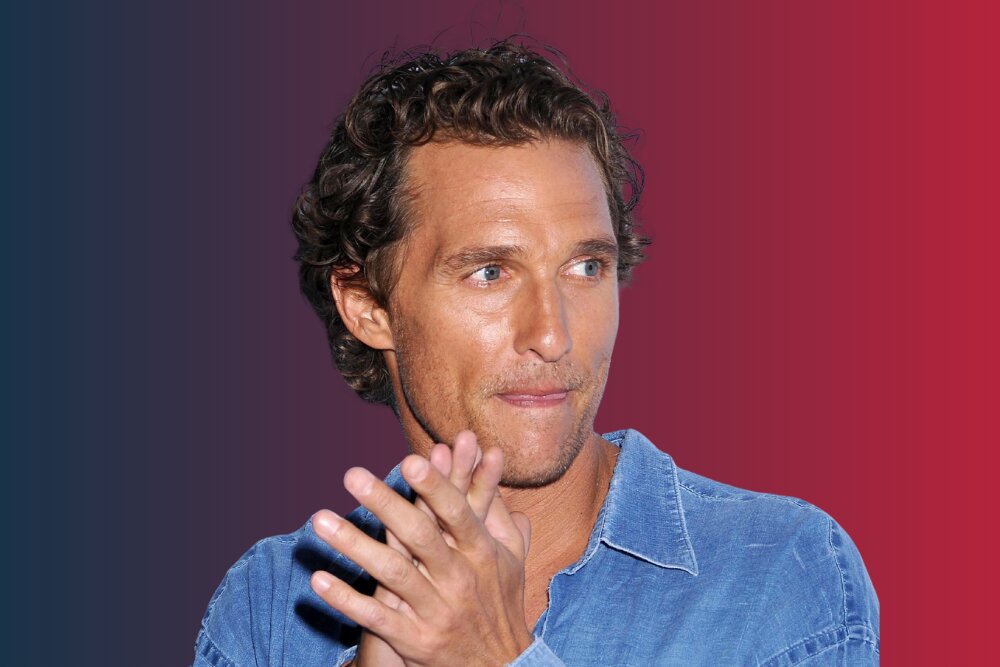

Matthew McConaughey has revealed that he once walked away from a staggering $14.5 million payday, a decision he says was crucial to redefining his career in Hollywood.
The 55-year-old actor shared the story in depth on the Graham Norton Show, reflecting on a period when he deliberately stepped away from his established image as a rom-com star.
McConaughey explained that he had grown weary of being pigeonholed in romantic comedies, despite the commercial success of hits like 2001’s The Wedding Planner and 2003’s How to Lose a Guy in 10 Days.
He said: “I've been trying to get dramas. I was even offering huge paycuts, and they were like: 'No, stay in your lane McConaughey. You're the romcom guy, got that down. Mind you, I enjoyed them. But I wanted to do something different. So I said, no more rom-coms.'”
After deciding to retreat to his ranch in Texas with his wife Camila Alves McConaughey, Matthew found that opportunities in the more serious acting realm were initially scarce. He recalled an 18-month period where nothing came through—until an offer arrived for an action comedy.
@bbc Matthew McConaughey turned down $14,500,000 #TheGrahamNortonShow #GrahamNorton #MatthewMcConaughey #Interview ♬ original sound - BBC
He detailed the negotiations: “$8 million offer. I read it. I said, 'No, thank you, that’s the stuff I’m not doing.’”
When the studio came back with more money, he remained firm: “They come back with a $10 million offer, ‘I’m not reading that again, no thank you.’ They come back with a $12 million offer, ‘Guys, tell them I said no thanks.’”
Even when the amount escalated to $14.5 million, McConaughey did not immediately accept. He explained with his characteristic humour: “They come back with a $14.5 million offer. I said, 'Let me read that again,’” he said light-heartedly. “I read it again, it’s the same words that were in the $8 million offer I said no to but it was better written.”
Despite the improved script, he ultimately chose to turn it down: “It was funnier, I could see myself in it, I could make this work. Anyway, I ultimately said, 'No.’”
Looking back, McConaughey believes that this decision was pivotal in sending a signal to Hollywood. “I think that me saying no to that $14.5 million offer sent an invisible message to Hollywood, ‘Oh, McConaughey is not bluffing. Oh he's playing offense. He's on to something’.”
The payoff, he says, was worth the wait. Approximately 20 months later, the serious roles he had been seeking finally came flooding in.
“20 months, 2 months after I turned that down, the offers came in, that I was looking for. And they came in in doves. It went: Killer Joe, Mud, The True Detective, Dallas Buyers, Magic Mike...'
'They would not have come in if I wouldn't have unbranded for that 20 months.”
This period of deliberate career recalibration, often referred to by fans as part of the “McConaissance,” saw McConaughey transition from the light-hearted rom-coms that first made him a household name to serious, critically acclaimed performances.
His decision to walk away from massive paychecks illustrates a rare instance of an actor prioritising creative growth over financial gain—a gamble that ultimately paid off and reshaped his Hollywood image.
Matthew McConaughey demonstrates his range in films such as Mud, where he played a fugitive with a complex moral code, and Magic Mike, portraying a seasoned stripper confronting personal and professional challenges.
His choices reflected a conscious effort to avoid being typecast and to pursue projects that challenged him as an actor.
The turning point in McConaughey’s career came with his portrayal of Ron Woodroof in Dallas Buyers Club, a performance that earned him the Academy Award for Best Actor.
He further cemented his dramatic credentials with his critically acclaimed role as Rust Cohle in True Detective, a dark and philosophically intense performance that showcased his depth on the small screen.
Over the past decade, McConaughey has balanced high-profile studio films with indie projects, earning respect from both audiences and critics for choosing roles based on character complexity and storytelling rather than commercial payoff.