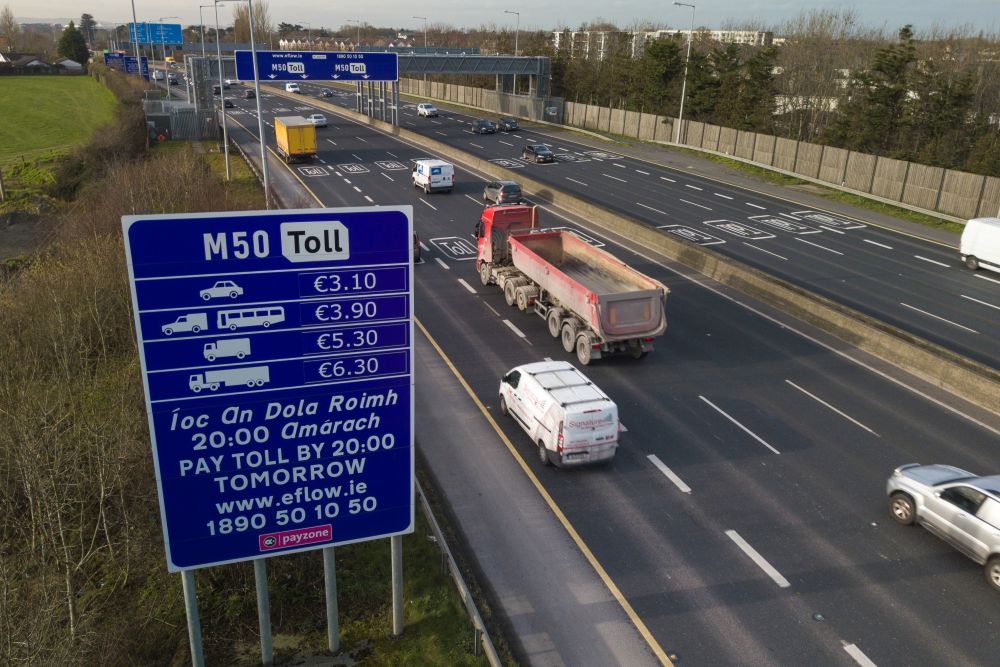

Journey times on the M50 have increased despite a toll hike introduced at the start of January, according to new data from fleet management company Geotab.
The toll increase, which came into effect on January 1st, saw most vehicles on the M50 charged an additional 10 cent per trip, while heavy goods vehicles over 10,000kg faced a 20 cent increase. Drivers without a tag or registered video account, who already pay a higher fee, were not affected by the latest rise. Tolls also increased on the Dublin Port Tunnel and several other motorways at the same time.
However, fresh analysis suggests the higher charges have not delivered the intended congestion relief. Geotab’s review of thousands of anonymised commercial journeys found that average travel times on the M50 in January 2026 were at least 3.5 minutes longer than during the same period last year.
Even where traffic volumes were similar or lower year-on-year, journey times during high-congestion periods were more than three minutes slower. Drivers were also found to be spending an additional eight minutes stationary on average, indicating what the company described as widespread stop-start traffic conditions along the route.
The data suggests motorists are increasingly attempting to avoid peak hours. Off-peak journeys accounted for three-quarters of M50 traffic in January 2026, compared with roughly two-thirds in January 2025. But the shift has not improved efficiency, with off-peak travel now taking longer than it did a year ago.
Congestion has worsened across nearly every weekday. The most significant deterioration during morning peak hours — between 7am and 9.30am — was recorded on Wednesdays, when journeys averaged 69.2 minutes, an increase of 18.4 minutes compared with last year.
Thursday afternoons between 4pm and 7pm were the slowest overall, with journeys averaging 72.8 minutes. This was the only peak period to record an improvement year-on-year, though travel times were still just 2.7 minutes faster than in January 2025.
Tuesday evenings experienced the sharpest spike in delays, with peak journeys taking 23.8 minutes longer than last year, reaching an average of 69.7 minutes.
Phil Barnes, Geotab’s business development manager for Ireland and the UK, said the figures raise serious concerns about the effectiveness of the toll increase.
“If the policy is not delivering congestion relief, it is simply adding cost,” he said.
According to Barnes, the data indicates that demand for the M50 has not decreased but instead appears to be compressed into different time periods.
“The M50 is not an optional route for commercial operators,” he said. “Any inefficiency, incident, or increase in congestion has a direct and significant knock-on effect on supply chains across the entire country.”
He added that what may appear to be a minor delay quickly escalates for fleet operators.
“A three-minute increase in average travel time may sound minor at first, but multiple journeys each day quickly translate into significant lost time,” Barnes said. “With logistics operators running at high efficiency and tight margins, the increased cost is a significant burden. A viable solution is urgently needed.”
Overall, the analysis shows that journeys on Ireland’s busiest motorway are taking up to 23 minutes longer than they were a year ago, despite the recent toll hike aimed at managing demand.