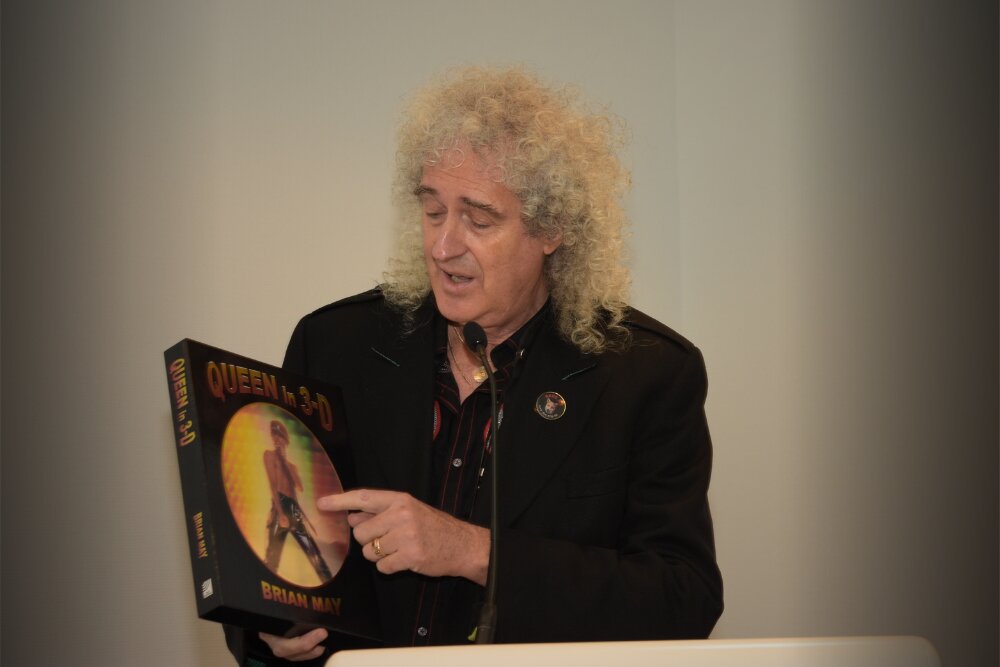

Queen will never perform at the Glastonbury Festival due to long-standing political differences with the event’s organisers, according to guitarist Sir Brian May.
The 77-year-old musician has said the band has never seriously discussed appearing at the world-famous festival because of his opposition to badger culling — a policy supported by Sir Michael Eavis, Glastonbury’s founder and a dairy farmer.
“They like killing badgers, and they think it’s for sport and that’s something I cannot support because we’ve been trying to save these badgers for years, and they are still being killed for years, so that’s the reason we’re missing out on it,” May said.
Glastonbury is currently on a scheduled fallow year, but the disagreement dates back more than a decade. Sir Michael Eavis, now aged 90, previously branded May “a danger to farming” due to his outspoken opposition to the badger cull, which was introduced to curb the spread of bovine tuberculosis in cattle.
When asked whether Queen had ever turned down offers to headline the festival, May explained that the issue had effectively ruled out any approach. “I don’t think the conversation of us doing has ever taken place because they know how I feel,” he said.
May has been one of the UK’s most prominent critics of the badger cull for years. In addition to his music career, he holds a PhD in astrophysics and is a leading animal welfare campaigner. He co-founded the Save Me Trust, which campaigns against the culling of wildlife and promotes non-lethal alternatives to disease control.
The guitarist has repeatedly argued that scientific evidence does not support the effectiveness of the badger cull and has accused successive governments of ignoring data that undermines the policy. His activism has included legal challenges, public campaigns and appearances at protests across England.
Despite never playing Glastonbury, Queen remain one of the most successful bands in British music history. Formed in 1970, the group have sold over 300 million records worldwide, with May’s guitar work central to hits including Bohemian Rhapsody, We Will Rock You and Don’t Stop Me Now. Since the death of frontman Freddie Mercury in 1991, the band have continued touring with Adam Lambert as lead vocalist.
Glastonbury, meanwhile, has hosted many of the world’s biggest acts over the decades, but May’s comments suggest that political and ethical differences will continue to keep Queen off its legendary stages.
The turning of the year is traditionally a moment for optimism, a symbolic reset where ambition outweighs anxiety, at least briefly.
For Brian May, that instinct is still there, even if it now sits uneasily alongside something darker.
In his annual New Year message to fans, the Queen guitarist struck a familiar, defiant tone: “new opportunities, new dreams, new challenges, new fulfilments.” He added, with trademark emphasis, “The FUTURE is still out there!! Let’s go find it!!”
But speaking more candidly in a recent interview with Radio Times, the 78-year-old admitted that optimism no longer comes easily.
“I feel despondent about the world of humans,” May said. “It keeps me awake at night. The cruelty, the ignorance, the lies, the rewriting of history.”
It’s a stark assessment, and one delivered without theatrics. May framed his concerns not as abstract unease, but as something deeply personal, something that actively disrupts his rest. At the heart of it, he believes culture still has a moral function. “I think an understanding and love of art and music make it impossible to be the kind of person who wants to go out and be cruel to others.”
That belief only sharpens his frustration. “There’s so much suffering in the world,” he continued, “why would we want to add to it? We’ve lost the ability to discuss things and respect other people’s point of view, we have a horrendous polarisation.”
For an artist whose career has been defined by collaboration and empathy, the loss of shared language feels existential. Yet May’s outlook isn’t one of total retreat. Even as he worries about the present, he remains committed to preserving and revisiting the past, particularly Queen’s formative work.
Fans have something tangible to look forward to with the forthcoming reissue of Queen II, long regarded as one of the band’s most ambitious early statements.
There’s a quiet symmetry to all of this. While May worries about where humanity is headed, he continues to believe in music as a connective force, something worth preserving, sharing, and questioning in public. If the future troubles him, it hasn’t stopped him from offering fragments of the past as a reminder of what collective creativity once looked like, and what it might still be capable of becoming.
Brian May has become the latest artist to have his say on the ongoing debate regarding AI in music.
This comes after over 1,000 artists came together to release a silent album, as a sign of protest against planned changes to copyright AI laws planned by the British Government. The Government have been planning to make changes to copyright laws, which would enable AI to develop and train their models using copyrighted work, without needing a licence.
Opposition to this have warned that if artists are not compensated for AI recreating and copying their work, it would lead to a decrease in creativity, with this opt out option putting a burden on artists.
Artists who came together to release this album, include Kate Bush, Damon Albarn, Annie Lennox, and was co written by Billy Ocean, Jamiroquai, The Clash, Imogen Heap, along with a number of composers, conductors, and producers, as well as a myriad of Oscar, Grammy and Brit Award winners.
Queen frontman, Brian May is now the latest musician to lead the campaign against AI, warning that “nobody will be able to afford to make music” if “monstrously arrogant” tech companies continue under UK government’s AI copyright rules.
“My fear is that it’s already too late – this theft has already been performed and is unstoppable, like so many incursions that the monstrously arrogant billionaire owners of Al and social media are making into our lives. The future is already forever changed", May said.
He added: “But I applaud this campaign to make the public aware of what is being lost. I hope it succeeds in putting a brake on, because if not, nobody will be able to afford to make music from here on in".
These AI proposals have also been criticised by household names like Paul McCartney, who warned that they could "rip off" artists. More on that here.
McCartney's comments were also echoed by Elton John. More on this here.