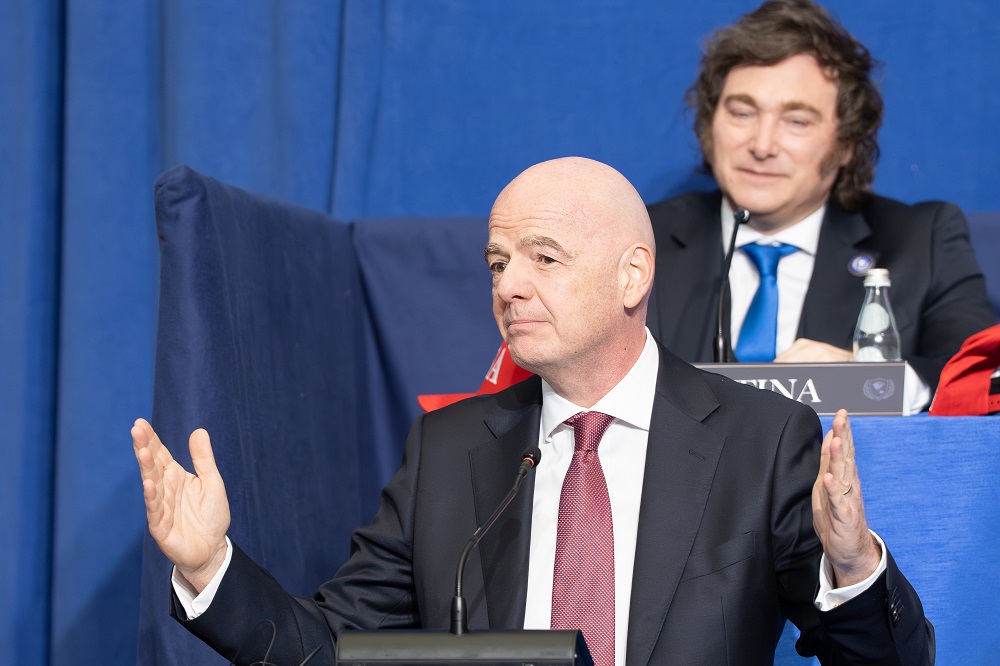

Mexico and Argentina have backed under-pressure FIFA president Gianni Infantino as opposition to his leadership continues to grow across world football.
Infantino has come under increasing scrutiny after football authorities across three continents rejected his controversial proposal to seek private investment in a company that would oversee FIFA competitions, including the men’s and women’s World Cups.
FIFA and Infantino apologised to national associations this week over the way the proposal was developed. However, members of FIFA’s management board who attended a meeting in Morocco on Wednesday said the president retained their “full support”.
Mexico’s football federation (FMF) has now publicly backed Infantino, saying it supported his call to “collectively continue developing football for the benefit of all 211 member associations”.
The FMF also said it supported “the leadership of President Infantino in continuing to promote the development of football through institutional strengthening”.
The statement is significant given that Mexico’s continental confederation, CONCACAF, strongly criticised Infantino last weekend. The confederation described the private investment proposal as a “unilateral and egregious act of poor governance” and called for a full review of his leadership.
Argentina’s football association, meanwhile, thanked Infantino for his decade in charge of FIFA and praised what it described as the transformation of the organisation under his leadership.
The AFA said that transformation had been achieved through a “transparent governance model”. Argentina is part of South American confederation CONMEBOL, which is currently lobbying FIFA to expand the 2030 World Cup to 64 teams.
CONMEBOL said on Thursday that it would not support efforts to remove Infantino through an accelerated process, while the Confederation of African Football (CAF) executive committee also expressed its “unanimous support” for the FIFA president.
Despite those endorsements, Infantino remains under significant pressure, particularly in Europe.
UEFA has maintained its threat to boycott FIFA competitions after declaring last week that it had “lost confidence” in Infantino. Norway’s football federation president Lise Klaveness told The Guardian on Friday that her board believed Infantino should resign.
“We decided that there is no trust in Infantino now,” Klaveness said, adding that there was “no way back” for the president in the eyes of the Norwegian federation.
Players’ union FIFPro has also accused Infantino of a “profound abuse of presidential power” and called for major governance reforms, including a players’ representative on the FIFA Council and involvement in FIFA’s promised review of the private investment proposal.
Meanwhile, members of the FIFA Council are reportedly seeking the 19 votes required to force a meeting at which Infantino could be held to account. If they fail, or if Infantino refuses their request, council members are considering a “governance boycott” by refusing to attend meetings in an attempt to disrupt FIFA’s operations.
LaLiga president Javier Tebas has also criticised Infantino, saying the failure to consult national associations, the FIFA Council and senior executives over the investment proposal represented a “grave breakdown of institutional governance”.
Tebas argued that the controversy was not even FIFA’s biggest scandal of the summer, pointing instead to the handling of the Folarin Balogun disciplinary case.
The US striker’s one-match suspension following a red card was controversially suspended, allowing him to play against Belgium, after US President Donald Trump said he had personally asked Infantino to review the sanction.
Tebas described the episode as “an intolerable political interference” in football’s disciplinary independence.
The English and Welsh football associations are among several European federations to have withdrawn their support for Infantino’s re-election bid ahead of next year’s FIFA Congress in Morocco.