

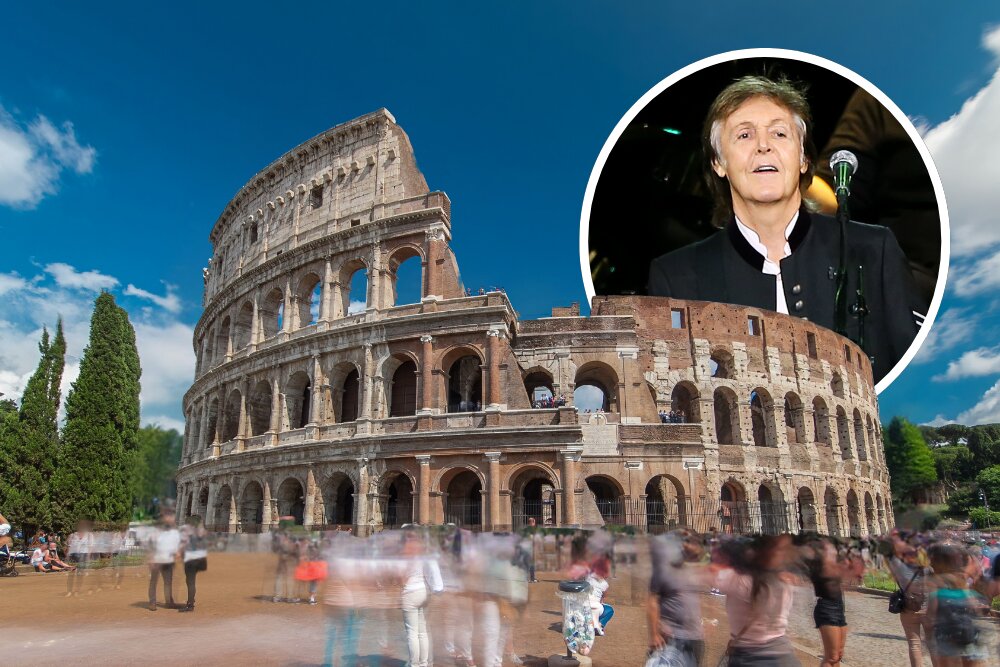
Twenty-three years ago, Paul McCartney made music history when he became the first major rock artist to perform at the iconic Colosseum in Rome. The landmark concert, held on May 10, 2003, marked a rare modern performance at one of the world’s most treasured ancient monuments — a venue more commonly associated with gladiators than guitars.
The former Beatle, already cemented as one of the most influential songwriters in history, delivered a special open-air show in front of the nearly 2,000-year-old amphitheatre, blending rock music with one of the most powerful backdrops in global cultural heritage. While concerts in Rome are nothing unusual, staging one adjacent to — and in view of — the Colosseum was unprecedented for a rock act at that scale.
At the time, McCartney was touring Europe and used the moment to create something visually unforgettable. The Colosseum, built between 70 and 80 AD under the emperors Vespasian and Titus, has long stood as a symbol of Roman engineering and endurance. To see it illuminated at night while McCartney performed songs from across his decades-spanning catalogue was, for many in attendance, a once-in-a-lifetime experience.
The setlist leaned heavily on classics that had already defined multiple generations. Songs originally penned during his time with The Beatles, alongside hits from Wings and his solo career, echoed around the ancient stone structure. Tracks like “Hey Jude,” “Let It Be,” and “Live and Let Die” took on added grandeur in a setting steeped in nearly two millennia of history.
The performance was as symbolic as it was musical. By 2003, McCartney had already played some of the world’s most famous venues — from Wembley Stadium to Madison Square Garden — but Rome’s Colosseum represented something entirely different. It was less about commercial spectacle and more about cultural significance.
The concert also reflected McCartney’s enduring ability to bridge eras. As a member of The Beatles, he helped shape the soundtrack of the 1960s. With Wings, he redefined himself in the 1970s. By the early 2000s, he had entered a new phase of his career — one where legacy and longevity were becoming as important as chart positions.
Performing at such a historic landmark required careful coordination with Italian authorities, given the Colosseum’s status as a protected UNESCO World Heritage Site. Strict preservation measures meant the event had to be meticulously planned to ensure the ancient structure was not compromised in any way.
The visual impact of the concert was striking. Floodlights bathed the Colosseum in warm tones while McCartney and his band performed against the Roman skyline. For fans, it wasn’t just another tour stop — it was a moment that reinforced his place not only in rock history but in cultural history more broadly.
More than two decades later, the performance remains one of the most unusual and memorable stops of McCartney’s post-Beatles career. It demonstrated that even after decades at the top of the music industry, he was still capable of breaking new ground.
Today, as McCartney continues to tour well into his eighties, that night in Rome stands as a reminder of his unique position in music: a rock star whose songs are timeless enough to resonate against the stones of the ancient world — and whose legacy continues to stretch across centuries.