

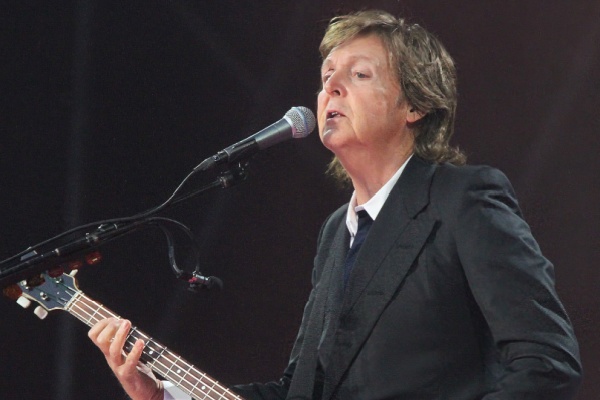
Paul McCartney has paid tribute to his former bandmate Len Garry, describing him as a “dear old mate” following the musician’s death at the age of 84.
Garry’s family confirmed that he died from pneumonia on Monday. The bassist was one of the early members of The Quarrymen, the skiffle group formed by John Lennon in Liverpool that would eventually evolve into The Beatles.
Sharing a photograph of the band’s early line-up, McCartney reflected on their friendship and the memories they shared during the group’s earliest days.
“My dear old mate from the Quarrymen, Len Garry, has passed away. He was a lovely guy and I’m sad to see him go but glad that we had so many fun times together. Rest in Peace Len, Love Paul.”
The tribute highlights a friendship that stretches back to the mid-1950s, when McCartney and Garry were teenagers in Liverpool and part of the city’s thriving skiffle scene. Both musicians became members of The Quarrymen, a group originally founded by Lennon while he was still at school.
The band’s early line-up featured John Lennon, Paul McCartney, Len Garry, Colin Hanton, Rod Davis, Pete Shotton, and Eric Griffiths. While the group performed a mixture of skiffle and early rock ’n’ roll covers, their biggest historical significance lies in the relationships formed within it.
It was through The Quarrymen that Lennon and McCartney first met in 1957, a meeting that would eventually lead to one of the most successful songwriting partnerships in music history. McCartney soon became a regular member of the band, with Garry playing bass during the group’s formative period.
Although Len Garry’s time in the band was relatively short, he was part of what many historians consider The Quarrymen’s first stable line-up. During this period, the group began performing regularly at local venues and community events around Liverpool, building the foundations of what would later become a global phenomenon.
However, Garry’s involvement with the group was cut short when he became seriously ill with tuberculosis in the late 1950s. The illness forced him to leave the band and spend an extended period recovering, meaning he stepped away just as the group began to transform.
In the years that followed, the band underwent several line-up and name changes, gradually evolving from The Quarrymen into the group that would eventually be known as The Beatles. George Harrison later joined the band, initially playing lead guitar, and the group’s sound moved away from skiffle towards the rock and pop style that would define the 1960s.
Despite leaving the group early, Len Garry remained a notable figure in the story of The Beatles’ origins, often remembered as part of the group’s earliest chapter.
Over the years he occasionally took part in reunions and events celebrating The Quarrymen, helping preserve the history of the band that played such a crucial role in shaping modern popular music.
The skiffle outfit itself has become legendary among fans and historians, as it represents the starting point for a musical revolution that would soon sweep the world.
The transition from The Quarrymen to The Beatles marked the beginning of a cultural shift that changed the direction of pop music forever.
For Paul McCartney, now one of the last surviving members connected to that earliest era, Garry’s death marks another poignant reminder of the passing of time since those teenage days in Liverpool.
His tribute reflects not only the loss of a former bandmate, but also of a friend from the formative years before global fame — when the future Beatles were simply a group of schoolboys experimenting with guitars, skiffle rhythms and the dream of making music together.
Paul McCartney Says Its 'Wonderful' To See So Much Of His Late Wife Linda In Man On The Run
Paul McCartney has said that it is "wonderful" to see "so much of" his late wife Linda in his new documentary, Man On The Run.
Wings were formed by Paul and Linda McCartney in 1971, a year after the Beatles split up. The band were also formed with former Moody Blues guitarist, Denny Laine.
"It's crazy; like a period of my life flashing before my eyes", McCartney said of this documentary on this website. "It's wonderful because it's full of different emotions and facets".
He continued: "One of the big things for me is seeing so much of Linda, which is great for me and the kids".
Following their split in 1981, Wings recorded seven studio albums, including Band On The Run. They are also best known for singles, Mull of Kintyre, Jet, Silly Love Songs, and Live and Let Die, the theme to the 1973 James Bond film.
"Overall, it's a success story. The big question after The Beatles was: How do you follow that? Do you not bother? Or if you try, how?", McCartney added. "I think we did it in a particularly madcap way, and that's what's good about the film: it shows how we pulled it off".
Man on the Run is out now on Prime Video.
Paul McCartney On Beatles Breakup: 'I Was Overbearing'
Sir Paul McCartney has candidly admitted he once “bought into” the criticism that he was responsible for the breakup of The Beatles, describing himself as “overbearing” during the band’s final years.
The 83-year-old music legend made the remarks while discussing his new Prime Video documentary, Paul McCartney: Man On The Run, directed by Oscar-winner Morgan Neville. The project charts McCartney’s life in the immediate aftermath of The Beatles’ split in 1970 and follows his determination to rebuild — both personally and professionally — through his solo work and later with his band Wings.
Reflecting on decades of public scrutiny, McCartney said: “Whenever I hear someone damning Paul McCartney, I tend to agree with them.”
He added: “So when everyone was saying I broke up the Beatles, and I was just overbearing and all of that, I kind of bought into it.”
For years, McCartney was widely perceived as the driving force behind the band’s final fractious period, particularly following the death of manager Brian Epstein in 1967. Tensions between McCartney, John Lennon, George Harrison and Ringo Starr had escalated during the recording of the White Album and Let It Be, culminating in McCartney announcing his departure in April 1970.
In more recent years, however, McCartney has sought to clarify the narrative, insisting that it was Lennon who first expressed a desire to leave the group privately in 1969. In interviews surrounding earlier archival projects, he has said he felt unfairly cast as “the villain” in the Beatles’ story.
The new documentary revisits that turbulent period but places particular focus on what came next — a chapter often overshadowed by Beatlemania. Man On The Run explores McCartney’s retreat to Scotland with his late wife Linda McCartney, his struggles with confidence, and the commercial uncertainty he faced launching a solo career while the shadow of The Beatles loomed large.
In previous interviews about that era, McCartney has admitted he experienced bouts of depression after the band’s split, once recalling: “I was pretty broken up. I thought, ‘That’s it. This is the end.’” The documentary reportedly revisits that vulnerability, highlighting how forming Wings in 1971 became both a creative outlet and a personal lifeline.
@paulmccartney
After the break-up of the biggest band in the world, what comes next? ‘Man on the Run’, the new documentary featuring rare unreleased music and footage from Paul McCartney, premieres February 25 on @PrimeVideo.
♬ original sound - Paul McCartney
Wings would go on to achieve major global success throughout the 1970s, with albums such as Band on the Run restoring McCartney’s critical and commercial standing. Yet, as the film shows, he continued to wrestle with the perception that he had fractured the world’s most famous band.
The emotional weight of the story has also surfaced during promotional events. At a screening in London earlier this year, McCartney admitted he felt “emotional” watching footage of Linda, who died in 1998. Her presence is central to the documentary, which portrays their partnership not only as romantic but as creative and stabilising during one of the most uncertain periods of his life.
Director Morgan Neville, known for intimate music portraits, has described the project as an examination of reinvention — how one of the most recognisable musicians in history navigated public blame, shifting cultural tastes, and the pressure to prove himself all over again.
Now more than half a century on from the Beatles’ breakup, McCartney’s reflections suggest a man at peace with the complexity of that moment. While he acknowledges that he could be “overbearing” in his drive to keep the band productive after Epstein’s death, he also recognises that the narrative was never as simple as one person ending a cultural phenomenon.
For fans, Paul McCartney: Man On The Run offers not just nostalgia, but a deeper look at resilience — and at the personal cost of being part of the most influential band in modern music history.
'Paul McCartney: Man On The Run': Every Song On The Soundtrack
Paul McCartney's life after 'The Beatles' will be explored in an all new documentary, 'Paul McCartney: Man On The Run'.
The new film directed by Morgan Neville documents McCartney's career as he exits The Beatles and forms his band 'Wings' with his late wife Linda.
'Paul McCartney: Man On The Run' will be available in selected cinemas today (February 19th) and on Amazon Prime on February 27th.
Amazon MGM said in a statement that "the film chronicles the arc of McCartney's solo career as he faces down a myriad of challenges while creating new music to define a new decade." They promised to provide "unprecedented access to previously unseen footage and rare archival materials" as it aims to capture McCartney's "transformative post-Beatles era through a uniquely vulnerable lens".
The documentary has so far received a flood of positive reviews with The Guardian awarding it 4/5 stars and stating that "it’s an engaging film, and there is always something mesmeric in McCartney’s face: cherubic, and yet sharp and watchful."
NME also awarded the film 4/5 stars and praised director Neville for the "excellent job" he did at "capturing the weight of expectations laid at McCartney’s door in April 1970, when he casually revealed that the Beatles were no more – despite the fact that John Lennon had quietly requested a “divorce” from the group seven months earlier."
According to NME, the full soundtrack will be released on February 27th, and is available here.
1. ‘Silly Love Songs (Demo)’ – Wings
2. ‘That Would Be Something (2011 Remaster)’ – Paul McCartney
3. ‘Long Haired Lady (2012 Remaster)’ – Paul and Linda McCartney
4. ‘Too Many People (2012 Remaster)’ – Paul and Linda McCartney
5. ‘Big Barn Bed (2018 Remaster)’ – Paul McCartney and Wings
6. ‘Gotta Sing Gotta Dance’ – Paul McCartney
7. ‘Live And Let Die (Rockshow)’ – Wings
8. ‘Band On The Run (2010 Remaster)’ – Paul McCartney And Wings
9. ‘Arrow Through Me (Rough Mix)’ – Wings
10. ‘Mull Of Kintyre (2016 Remaster)’ – Wings
11. ‘Coming Up (2011 Remaster)’ – Paul McCartney
12. ‘Let Me Roll It (2010 Remaster)’ – Paul McCartney and Wings