Project Hail Mary has delivered one of the most unusual film premieres in recent memory — quite literally launching itself into the stratosphere.
In a bold marketing move, Sony Pictures partnered with aerospace specialists Sent Into Space Ltd to send a specially engineered IMAX display unit 110,000 feet above Earth, where it played footage from the film’s London premiere before screening the movie itself in its expanded IMAX format.
While no audience was physically present at that altitude, the entire stunt was captured on camera, creating what is arguably one of the most ambitious promotional campaigns ever staged for a blockbuster release.
The space-set epic, led by Ryan Gosling, has already proven that the spectacle isn’t limited to its marketing.
The film has rocketed to a $140.9 million global debut, making it the biggest box office opening of 2026 so far.
That figure includes $80.5 million in North America and $60.4 million internationally, comfortably outpacing competitors and marking a major milestone for Amazon MGM Studios.
In fact, it now stands as the biggest opening in the studio’s history, surpassing previous releases and signalling Amazon’s growing ambitions in the theatrical market.
Directed by the filmmaking duo Phil Lord and Christopher Miller, best known for hits like The Lego Movie and 21 Jump Street, the film is adapted from the bestselling novel by Andy Weir.
Weir previously wrote The Martian, which became a global box office success, and Project Hail Mary follows a similarly science-driven narrative with a strong emotional core.
The story centres on a former molecular biologist and schoolteacher, played by Gosling, who wakes up alone aboard a spacecraft with no memory of how he got there. As his memory gradually returns, he realises he is humanity’s last hope, tasked with saving Earth from an extinction-level threat caused by a mysterious space phenomenon. Along the way, he encounters an unexpected ally — a small, rock-like alien — forming an unlikely bond that becomes central to the film’s emotional and narrative arc.
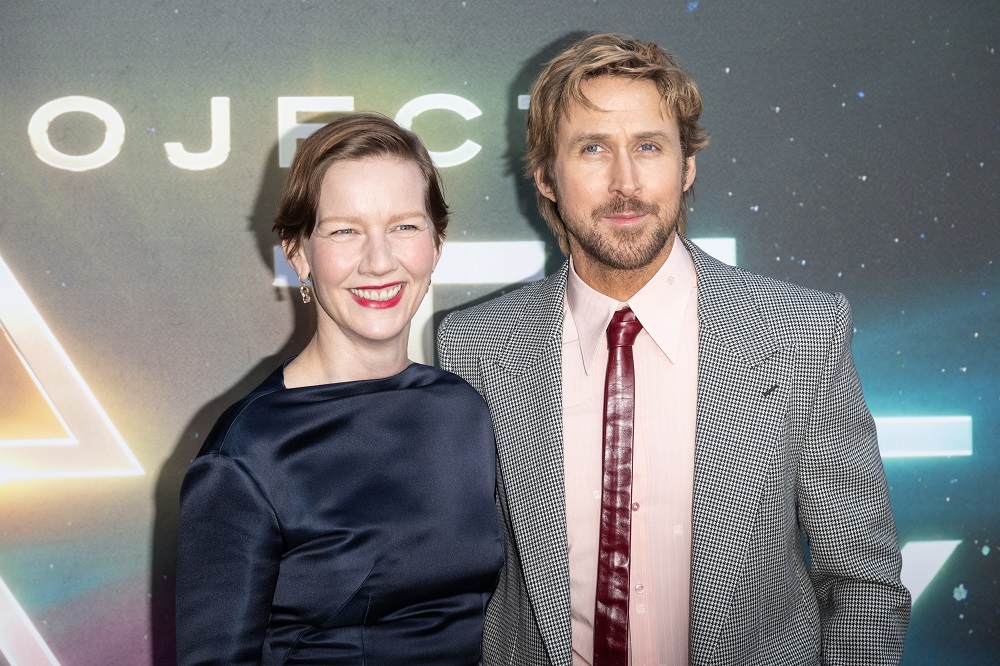
The cast also includes Sandra Hüller, alongside a supporting ensemble that grounds the high-concept sci-fi story in human stakes.
Critically, the film has been met with an exceptionally strong response.
It has earned some of the highest review scores of the year on Rotten Tomatoes, with critics praising its balance of spectacle, humour, and emotional depth.
Many have highlighted Gosling’s performance in particular, as well as the film’s ability to translate complex scientific ideas into a compelling cinematic experience. Industry analysts have pointed to this rare combination of critical acclaim and audience enthusiasm as a key factor behind its strong opening.
The success is also significant for Amazon MGM, which has spent heavily in recent years to establish itself as a major theatrical player following its $8 billion acquisition of MGM.
After a slow start to 2026 with underperforming releases, Project Hail Mary is shaping up to be the studio’s first major commercial hit, with analysts suggesting it could have strong legs at the box office in the weeks ahead.
Notably, it joins a small group of original, non-franchise films — alongside Oppenheimer — to achieve a major international opening in the post-pandemic era.
IMAX has played a crucial role in the film’s success, contributing $27.6 million to the global total. The format’s expanded aspect ratio and immersive visuals have been heavily emphasised in both the marketing and the viewing experience, with industry figures noting the long-standing connection between IMAX and space-themed storytelling.
The stratospheric “premiere” only reinforced that link, blurring the line between film promotion and technological spectacle.
Although Project Hail Mary isn’t technically the first film to screen in space — that distinction is often attributed to the 2011 documentary First Orbit, which premiered aboard the International Space Station — it is by far the most high-profile example in the blockbuster era.
The ISS itself has been equipped with viewing technology for astronauts since 2015, but no major Hollywood release has leaned so heavily into the concept as part of its launch strategy.
With a massive opening weekend, strong critical backing, and a marketing campaign that has quite literally gone above and beyond, Project Hail Mary is shaping up to be one of the defining cinematic events of the year — both on Earth and far beyond it.