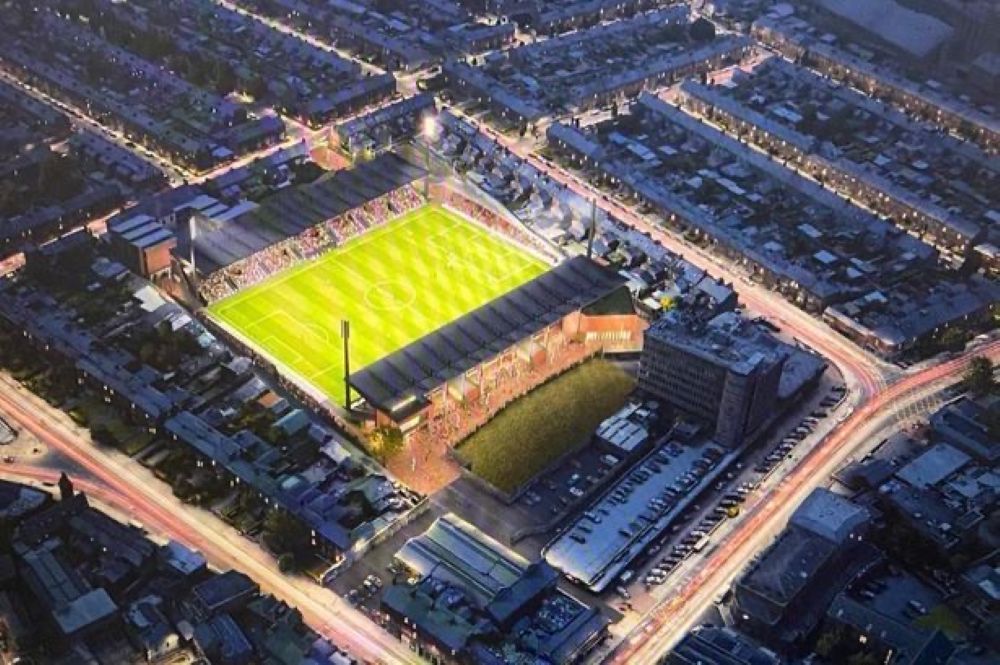

The cost of redeveloping Dublin’s Dalymount Park has more than tripled since Dublin City Council (DCC) bought the stadium a decade ago. The council now plans to borrow €34 million to help fund the long-awaited modernisation of the League of Ireland ground.
In 2015, DCC purchased the historic stadium from Bohemian Football Club for €3.8 million, and a year later announced redevelopment plans estimated at €20 million. The original vision aimed to accommodate both Bohemians and Shelbourne FC, following the council’s acquisition of Tolka Park in nearby Drumcondra.
However, the plan changed after Shelbourne supporters successfully campaigned to keep their traditional home at Tolka Park.
By 2022, new plans were unveiled to demolish and rebuild Dalymount Park, with the cost rising to €40 million. Last year, planning permission was granted for an 8,000-capacity stadium, but the latest figures presented to councillors show the price tag has now soared to €63.75 million.
Of this, around €25 million will come from government funding, while DCC will borrow €34 million to get the project underway. According to the council, repayments will be partly covered by annual rental income, matchday revenue, and non-matchday events.
Planning permission is also to be amended in an effort to save approximately €3.5 million, with work expected to begin at the end of 2026 or early 2027. The redeveloped Dalymount Park is scheduled to open in time for the 2029 League of Ireland season.
Bohemian Football Club welcomed the decision by councillors to approve the funding, saying:
“This is the final step in a process that began with DCC acquiring Dalymount exactly 10 years ago. It will allow for the historic stadium to be fully redeveloped and serve the people of Dublin and beyond long into the future.”
The club added:
“Bohemian FC contributes to Irish society through sport, community engagement and progressive social policies – a redeveloped Dalymount Park will ensure we can continue to do so and build upon it.”
During the council meeting, councillors raised concerns about stadium capacity, eligibility for hosting European football, and potential cost overruns.
Dublin City Council CEO Richard Shakespeare said that upgrading the design to meet UEFA’s top-tier requirements would involve “a whole different level of pain financially.”
Meanwhile, Don Daly, the council’s Capital Projects Manager, explained that Bohemians’ choice to include standing terraces was “part of the reason the stadium could not be built to Category 4 standards.”
Mr Shakespeare assured councillors that operational details are still being finalised, adding that “the estimated costs have a whole range of contingencies built into it” and expressing confidence that the project will be delivered within budget.