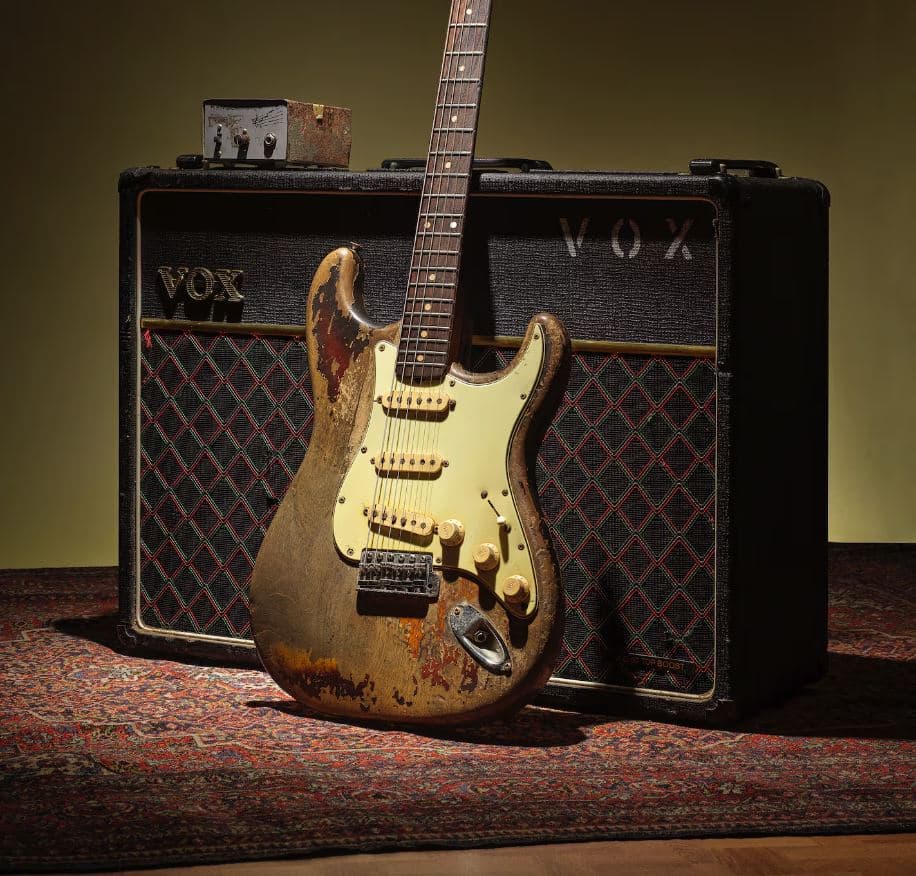

One of the most storied instruments in Irish music history has found its permanent home. Rory Gallagher’s beloved Fender Stratocaster, the weathered, road-worn guitar that powered countless blistering blues performances, is now officially on display at National Museum of Ireland, Decorative Arts & History at Collins Barracks.
This is no ordinary acquisition. Gallagher famously bought the Strat for £100 in 1963 at Crowley’s Music Store in Cork. Six decades later, the instrument sold at auction for over €1 million at Bonhams in London. The buyer, Live Nation Gaiety Ltd, donated the guitar to the National Museum, ensuring it remains part of Ireland’s cultural story rather than disappearing into private hands.
The Stratocaster’s arrival headlines “The Changing Ireland Galleries,” the most significant expansion at Collins Barracks in more than 20 years. This new exhibition space brings together over 250 artefacts, inviting visitors to explore Irish life through political, social, and cultural milestones.
Visitors are greeted by a question on entry: “Cad Is Ann Éire Dar Leat?” , “What is Ireland to you?” Gallagher’s guitar sits among objects that have shaped and reflected that evolving answer over 150 years.
The galleries are designed for rotation, meaning more of the National Museum’s vast collection will see daylight than ever before. Many artefacts are being displayed publicly for the first time. Among them: a decommissioned RPG7 used by the IRA during the 1970s, Countess Markievicz’s Irish Transport and General Workers’ Union badge, and a steam press from the Donnybrook Magdalene Laundry.
There’s also a pair of Berlin wool slippers once worn by Michael Collins while in hiding during the War of Independence, and the purple inauguration suit of Mary Robinson designed by Louise Kennedy.
“This is a transformational moment for the National Museum,” said director Lynn Scarff. “The galleries invite visitors to connect with history on their own terms and to question what Ireland means to them today.”
Patrick O’Donovan, Minister for Culture, Communications and Sport, described the project as “a legacy of the Decade of Centenaries Programme and a testament to the power of cultural reflection.” Tánaiste Simon Harris added that the display “reminds us that our shared history is not static but continues to evolve with every generation.”
For Gallagher’s Stratocaster, battered, sweat-stained, and immortalised on stage, it’s a fitting tribute. An instrument that helped define Irish rock now stands alongside the nation’s defining artefacts, enshrined not as a relic, but as living history.