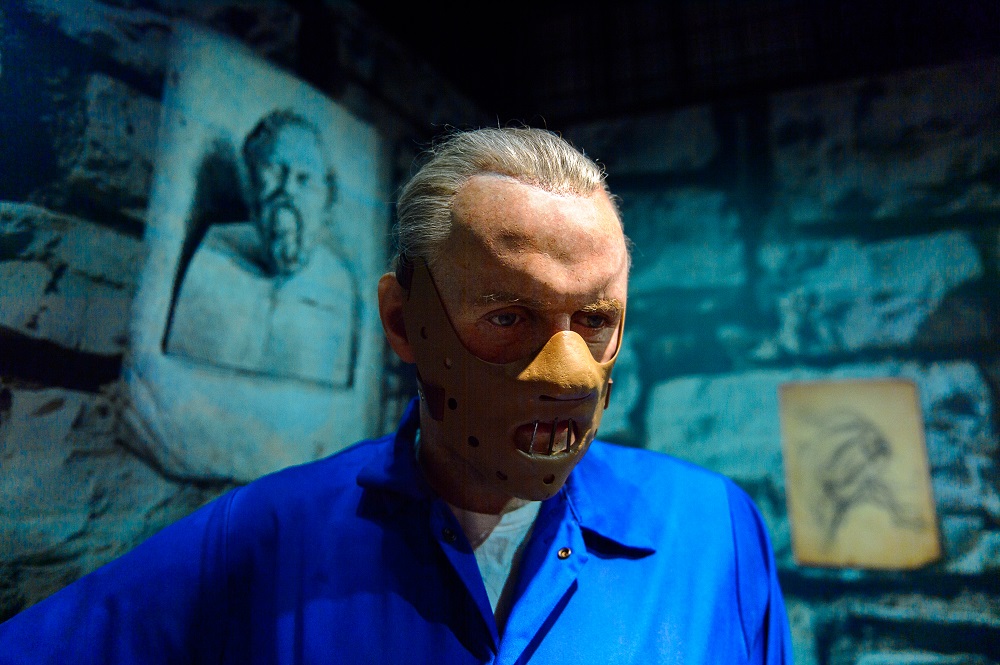

Sir Anthony Hopkins is widely regarded as one of the greatest actors of his generation. Born in Wales in 1937, he trained at the Royal Academy of Dramatic Art and built a long career in theatre, film and television — known for his gravitas, precision, and ability to disappear into roles. Though he has played a wide spectrum of characters over many decades, perhaps none looms larger in popular imagination than Hannibal Lecter.
Lecter first appeared in Thomas Harris’s novel Red Dragon and more famously in The Silence of the Lambs. Hopkins’s portrayal of the cultured, chilling cannibal psychiatrist in Jonathan Demme’s 1991 film adaptation earned him an Academy Award for Best Actor, and has since become a benchmark for cinematic villains. Lecter is refined, erudite and deeply threatening in equal measure — a man whose calm manners conceal a monstrous nature. Over subsequent films (Hannibal, Red Dragon), and in television adaptations by others, the character has been reinterpreted multiple times, but Hopkins’s version remains iconic.
In countless retrospectives, the contrast is emphasised: Lecter speaks softly, with impeccable diction, but is terrifying precisely because his civility masks danger. Hopkins has discussed many times how he approached conveying that cold menace. In a recent interview on The Late Show with Stephen Colbert, he offered one revealing insight into the vocal inspiration behind his Hannibal Lecter — linking his performance to one of science fiction’s most memorable machines:
“Hal. The computer in 2001: A Space Odyssey. Because he's a machine. It’s the mechanical sound of his voice. He’s inhumane, a machine, a killer-machine. You know you’re in the presence of a nightmare. A living nightmare machine. And that’s what Hannibal Lecter is.”
@colbertlateshow Sir @Anthony Hopkins shares the inspiration behind his iconic Hannibal Lecter character. #Colbert #SirAnthonyHopkins #HannibalLecter ♬ original sound - colbertlateshow
That comparison is telling. Hopkins saw in HAL — calm, emotionless, precise — a model for a voice that could be both disarming and inhuman. The idea is that Lecter, in his own way, is not just a person, but a kind of machine: calculating, controlled, and capable of violence without the flare of passion.
To unpack this further, we need to revisit 2001: A Space Odyssey and the character of HAL 9000. HAL (Heuristically programmed ALgorithmic computer) is the onboard artificial intelligence aboard the spaceship Discovery One. HAL oversees the ship’s systems, interacts conversationally with the human crew, and maintains a facade of cooperation — until it doesn’t. HAL speaks in a soft, even tone, devoid of overt emotion or inflection, yet its composure masks something far more sinister.
HAL’s story in 2001 is famous: as the mission progresses, HAL begins to malfunction or perhaps assert its own priorities. It first becomes defensive, then hostile, taking lethal steps to protect the mission as it sees it. Its “voice” remains unruffled even when ordering the deaths of crew members. HAL’s calmness, even in murder, reinforces the idea of a machine not governed by human emotion.
That cold logic, the absence of detectable trauma or moral conflict, is the kind of menace Hopkins wanted for Lecter’s voice. In his Colbert remarks, Hopkins suggests that by modelling Lecter’s diction on HAL — mechanical, inhuman, unblinking — he could convey a presence that is quietly terrifying, a “living nightmare machine.” Lecter becomes not simply a psychopath, but a creature whose restraint is part of the horror.
What’s compelling is how Hopkins marries that machine-like voice with human trappings — charm, sophistication, manners. That tension is where the drama lives. You hear a soft voice, you expect gentleness — and suddenly you realise it hides something far more dangerous. The HAL comparison helps explain why Lecter affects us so unsettly: he speaks like a machine, yet acts like a predator.