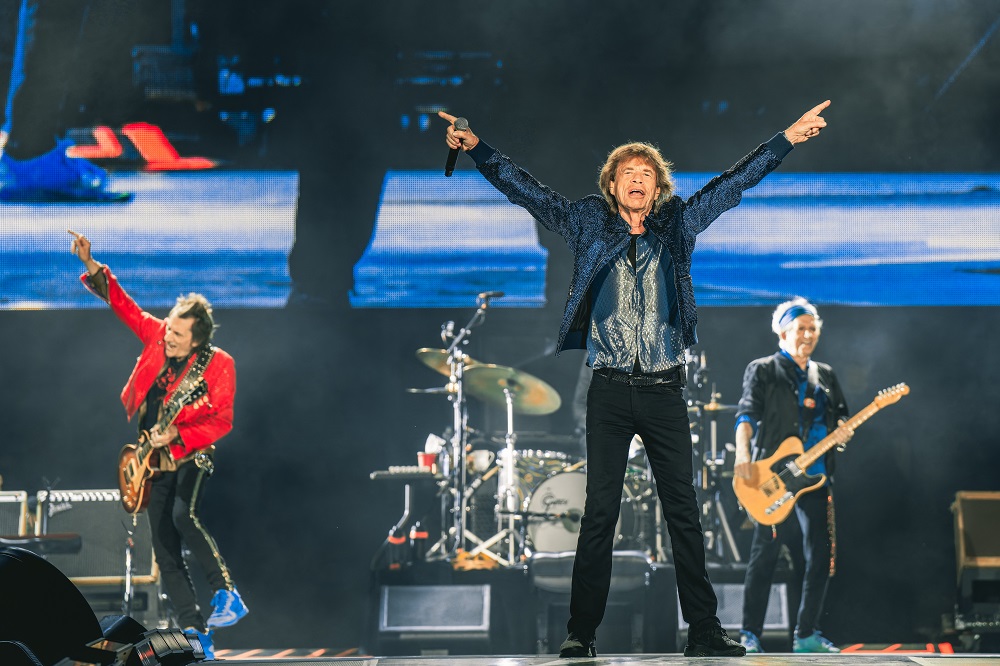

The relationship between The Rolling Stones and David Bowie was never simple. It was part admiration, part rivalry, part overlapping orbit. Two forces moving through the same musical decade with very different trajectories, occasionally colliding in unexpected ways.
By the late 1960s, the Stones were already an institution. From early singles like Come On and I Wanna Be Your Man through defining Jagger-Richards compositions such as (I Can’t Get No) Satisfaction, The Last Time, and The Last Time, and culminating in Let It Bleed, they had defined the sound and attitude of the era. Bowie, by contrast, spent most of the decade searching for a foothold, his first real breakthrough arriving only at the very end with Space Oddity.
The 1970s changed that balance. Bowie exploded into cultural dominance with Starman, Ziggy Stardust, and the shifting personas that followed. Yet even as Bowie reinvented himself, the Stones remained a looming presence, particularly on Sticky Fingers and Exile on Main St., records that reaffirmed their creative authority well into their second decade.
Bowie felt that influence deeply. His early-’70s work, including The Man Who Sold the World, leaned harder into rock textures, and Mick Jagger’s swagger can be traced through the Ziggy Stardust persona. Bowie even paid direct tribute on Aladdin Sane, covering the Stones’ 1967 single Let’s Spend the Night Together.
So when Bowie and the Stones ended up in the studio together, it wasn’t the result of a grand plan, just proximity, momentum, and mutual familiarity.
The song in question was It's Only Rock 'n Roll (But I Like It). Unlike the rest of the album it would eventually title, the track was recorded separately at Ronnie Wood’s home studio. At the time, Wood wasn’t yet an official Stone. Faces were falling apart, and he had just released his solo album I’ve Got My Own Album to Do. He wouldn’t formally replace Mick Taylor until the following year.
That didn’t stop the session from turning into an informal supergroup. Wood played guitar, Kenney Jones handled drums, Willie Weeks played bass, and longtime Stones collaborator Ian Stewart was on piano. Mick Jagger sang lead, Keith Richards played guitar, and David Bowie contributed backing vocals.
It wasn’t a headline-grabbing feature. Bowie’s voice is woven into the texture rather than spotlighted. But he clearly valued the experience. During live performances of Diamond Dogs in 1974 and 1976, Bowie would occasionally shout the song’s title mid-performance, a private nod to the collaboration.
A decade later, Bowie and Jagger would reunite far more visibly for their rushed but iconic cover of Dancing in the Street, recorded for Live Aid in 1985 after technical limitations made a live transatlantic duet impossible.
But It’s Only Rock ’n Roll (But I Like It) remains the subtler meeting point, a moment where two towering figures overlapped without spectacle, leaving behind a classic that still carries Bowie’s voice, hiding in plain hearing.